



Fox EP12 vs CQ7: Which Battery Is Right for Your Home? Leave a comment
If you are looking at Fox ESS battery storage at the moment, two of the most useful options in the range are the Fox EP12 and the newer Fox CQ7. They do a similar job, but they suit slightly different installations.
The short version is simple: the EP12 is a very neat option when you want a relatively large amount of storage from a single wall-mounted battery, while the CQ7 makes more sense when you want a modular floor-standing stack that can be expanded in smaller steps.
Fox EP12 vs CQ7 at a glance
| Specification | Fox EP12 | Fox CQ7 |
|---|---|---|
| Battery type | LFP (LiFePO4) | LFP (LiFePO4) |
| Nominal capacity | 11.52kWh per battery | 7.02kWh per module |
| Typical configuration | Single wall/floor-mounted battery | Modular master + slave stack |
| Depth of discharge | 90% | 90% |
| Round-trip efficiency | 95% or better | Over 95% |
| Expansion | Up to 4 batteries in parallel | Up to 14 modules in series |
| Best suited to | Compact high-capacity domestic installs | Flexible, scalable battery systems |
Those figures are based on the current Fox ESS technical data for the EP12 and CQ7.
Why choose the Fox EP12?
The EP12 stores 11.52kWh in a single battery, so it is particularly useful where you want a decent amount of storage without building a tall battery stack.
It is also quite slim at 185mm deep, with overall dimensions of 710mm wide by 640mm high. That makes it a useful option for garages, utility areas and suitable external walls where floor space may be limited.
For many normal domestic properties, one EP12 is already a meaningful amount of storage. If more capacity is required later, Fox allows multiple EP12 batteries to be installed in parallel, subject to the inverter and system design being suitable.
The EP12 generally makes sense if:
- you want around 10-12kWh of storage from a single battery;
- you prefer a wall-mounted installation;
- you want a relatively shallow battery;
- you may want to add another EP-series battery later.
Why choose the Fox CQ7?
The CQ7 takes a more modular approach. Each module is 7.02kWh, with a CQ7 master forming the base of the system and additional slave modules added to build the required capacity.
For example, a two-module CQ7 system provides 14.04kWh of nominal storage, while three modules provide 21.06kWh. This makes it particularly useful when a customer wants to build a larger system without jumping straight from one very large wall-mounted battery to another.
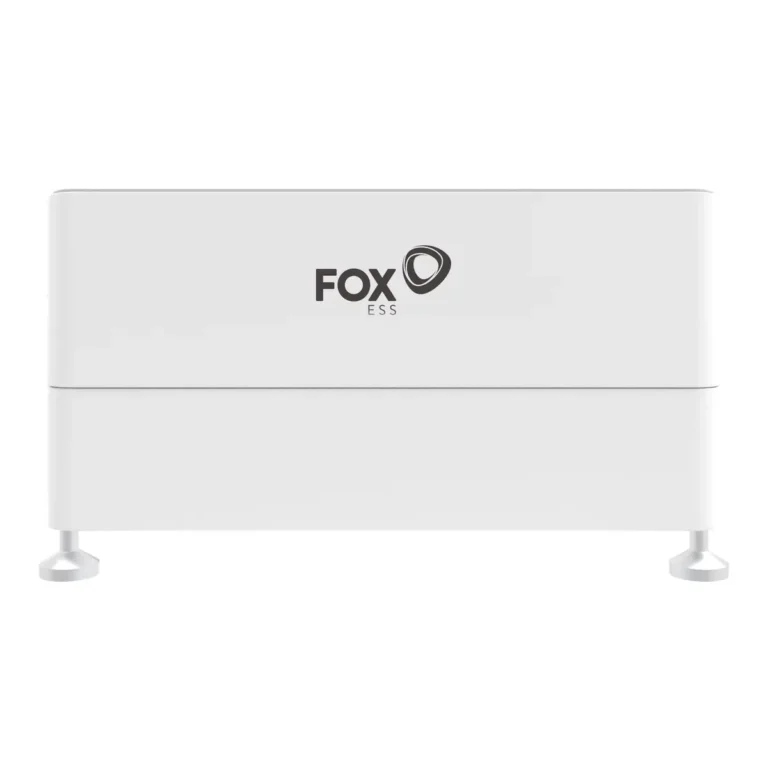
The CQ7 is a floor-standing stack rather than a wall-mounted battery, so the available installation space matters. The trade-off is much greater scalability: Fox’s current specification allows up to 14 CQ7 modules in series.
The CQ7 generally makes sense if:
- you want 14kWh or more of storage;
- you want a modular system that can be expanded in 7.02kWh steps;
- you have suitable floor space for a battery stack;
- you are planning a higher-capacity system for heavier electricity use.
How much battery storage do you actually need?
This is the more important question. Bigger is not automatically better.
Battery capacity should be considered alongside your daily electricity use, solar generation, tariff, inverter output and what you are actually trying to achieve. Someone using 8kWh a day has very different requirements from a property using 25kWh a day with an EV and heat pump.
The Energy Saving Trust notes that there is no single exact formula for battery sizing and gives around 10kWh as a typical domestic system. In practice, we would rather size a battery around the property than simply fit the biggest system available.
If you are on a time-of-use tariff, battery capacity can also be used to shift cheap overnight electricity into more expensive daytime periods. We cover tariffs and battery optimisation in more detail over at Battery Boost.
What about inverter power?
Battery capacity and inverter output are separate things. A 20kWh battery does not automatically mean the house can draw 20kW from it.
The inverter determines how quickly energy can be supplied to the property. For example, a 5kW battery inverter can normally provide up to around 5kW continuously even if a much larger battery is connected.
This is why we look at both kWh of storage and kW of inverter output when specifying a system.
Which one would we normally choose?
For a straightforward domestic installation needing roughly 10-12kWh, the EP12 is difficult to overlook. It gives a lot of storage from one battery and keeps the installation tidy.
Once the required storage moves beyond that, the CQ7 becomes increasingly interesting. Two CQ7 modules give 14.04kWh, three give 21.06kWh, and the modular format makes it easy to design around higher-consumption properties.
There is no universal winner between the two. The best option depends on the available space, required capacity, inverter, existing equipment and whether future expansion is likely.
Need help choosing?
You can use our Battery Storage System Builder to narrow down suitable options based on your property and energy use.
If you would rather have the system supplied and installed, see our Solar & Battery Installation service. We can also help with retrofit battery systems where solar is already installed.
For a broader introduction to the subject, our Solar Battery Storage: A Practical Guide explains how home battery systems work and what to consider before buying.
